
The Story Behind the Ohio State Flag's Unique Shape
You might think a state that’s been part of the Union since 1803 would’ve had its iconic flag from day one, but Ohio did things a little differently. It took nearly 100 years for the Buckeye State to officially hoist its own banner alongside the Stars and Stripes, but when it finally did, it broke the mold! Ohio's flag stands out from the crowd with its distinctive shape, making it one of a kind among US state flags.
From early proposals to the Pan-American Exposition, Ohio's journey to adopt a state flag is packed with history, patriotism, and symbolism. Join us as we explore how the Ohio flag came to be, what it means, and why it looks so different from the rest.
When Was the Ohio State Flag Adopted?
Despite joining the Union on March 1, 1803, Ohio did not have an official state flag for almost a century. State militias instead had their regimental flags based on the American flag. In 1860, Generals David L. Wood and Henry B. Carrington proposed a state flag design that was simply the state seal on a white background. However, in January of 1861, Wood and Carrington attended a speech by future president James A. Garfield, who argued that Ohioans should march under the national flag. The Generals agreed, scrapped their design, and instead fought under Union flags during the Civil War.
During the Pan-American Exposition in 1901, architect John Eisenmann was asked to design Ohio’s exhibition hall. He created a set of four flags to be flown at the building’s corners, bearing the design we know today. The following year, State Representative William S. McKinnon, who had been part of Ohio’s Pan-American Exposition Commission, proposed Bill 213 to adopt Eisenmann’s design as the official state flag. It was formally adopted on May 9, 1902.
What Does the Ohio Flag Represent?
According to the Ohio Revised Code, the state flag of Ohio contains multiple symbols and meanings. The five red and white stripes pay tribute to the stripes on the American flag, in addition to representing the state’s roads and rivers.
Instead of having a rectangular blue canton like the American flag, Ohio’s flag has a large blue triangle spanning the hoist end, in honor of the state’s mountains and valleys. The triangle contains 17 white stars, with the 13 surrounding the large ‘O’ standing for the Original Colonies, and the additional four stars representing Ohio’s status as the seventeenth state to join the Union. The white ‘O’ refers to both the first letter of the state’s name, as well as the state nickname: the Buckeye State. Buckeye trees are native to Ohio and its neighbors, with the tree’s name stemming from the resemblance of its seeds to the eyes of deer (‘bucks’).
Why is the Ohio Flag Different than Other US State Flags?
Ohio’s flag is the only US state flag that doesn’t follow the traditional rectangular design. Instead, the Ohio flag shape is classified as a triangular swallowtail, with ‘triangular’ referring to the narrowing of the top and bottom of the flag, and ‘swallowtail’ for the notch on the flag’s fly end. As the name suggests, this design is based on a barn swallow’s tail, which splits into two points.


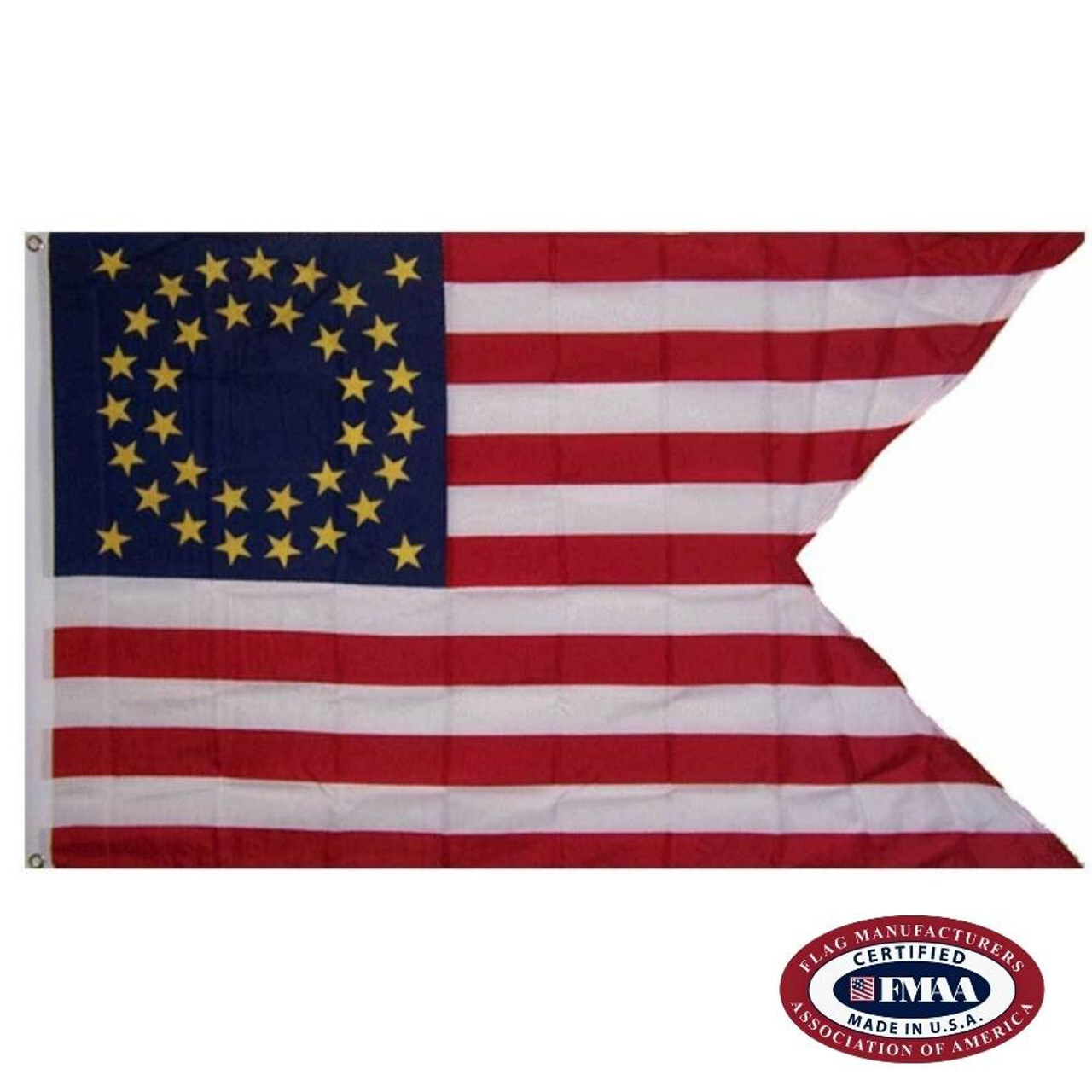
Eisenmann likely chose the swallowtail design to honor the guidons carried by the Ohio state militia during the Civil War. These guidons had previously represented Ohio before an official state flag was adopted.
How to Fold the Ohio Flag
Due to the flag’s unique shape, an official method for folding Ohio flags wasn’t developed until the 21st century. Boy Scout Alex Weinstock devised a method for his service project, which was approved as Bill 552 on February 15, 2005. The process requires two people and results in a total of seventeen folds, representing Ohio as the seventeenth state to join the Union.
According to the Ohio Revised Code, the steps are as follows:
- With the flag unfolded, fold the flag in half lengthwise so that the points of the flag are aligned.
- Fold the flag in half lengthwise a second time to form a long strip with the red disc facing the ground.
- Fold the pointed end back onto itself to form a rectangle.
- Starting on the end formed by the fold of the pointed end back onto itself, fold two inches of the flag onto itself for a flag with a three-foot hoist and a five-foot fly, or another appropriate width of fold for a flag of a different size.
- Repeat the folds a total of fourteen times, alternating the folds in a fan-like manner.
- Finally, neatly and snugly wrap the remaining length of flag around the fan-folds to form a compact rectangle.
From its late arrival to its bold, recognizable design, the Ohio state flag reflects the state's independent spirit and rich history. It may have taken nearly a hundred years for Ohio to fly its own banner, but when it did, it made sure it was like no other in the nation. With its swallowtail shape and references to the state’s landscapes and heritage, the Ohio flag is a proud reminder of what makes the Buckeye State special.
Whether you’re displaying the Ohio flag at your home, business, or during a parade, remember: you’re flying a piece of history that honors Ohio’s place in the United States and its enduring contributions to the USA.
Recent Posts
-
Honoring the Families of Fallen Soldiers: Gold Star Mother's and Family's Day
When a soldier dies during active duty, the loss reverberates through the service member’s family an
-
You Are Not Forgotten: National POW/MIA Recognition Day
Since the advent of war, soldiers have been taken as captives by opposing forces (POW, or Prisoner o