

Description
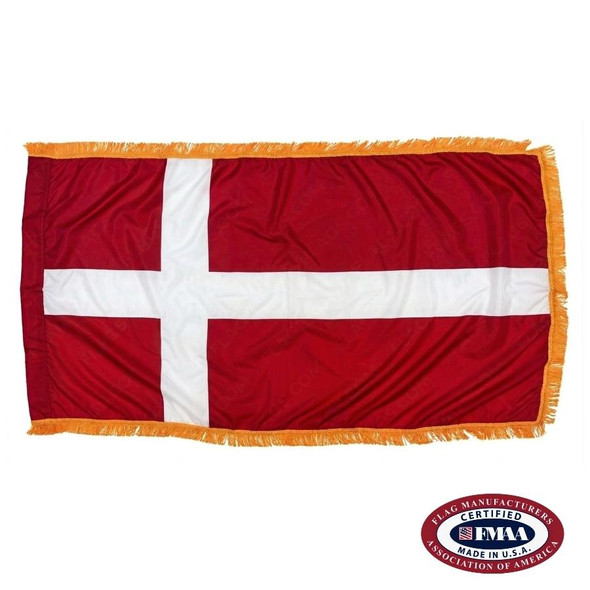
Proudly fly the national flag of Denmark outside your home or business!
Each Danish flag is made in the United States from high-quality nylon, a lightweight fabric that flies easily, even in gentle winds. Nylon’s lightness also makes it dry quickly after rain, helping prevent mildew growth. The iconic Nordic cross and red background are digitally printed with UV-resistant inks for vibrant colors that are fade-resistant, even when flown in direct sunlight.
Our Denmark flags come equipped with a durable canvas header and brass grommets for simple installation on an outdoor flagpole. We offer these flags in various sizes; refer to our table of pole heights and their recommended flag size to help you decide which option is best for you. The 3’ by 5’ flag is our bestselling size and an excellent match for our popular 6’ tangle-free house-mounted flagpole.
Denmark Flag Features
- Proudly manufactured in the USA
- Authentic 1625 design
- 100% pure nylon
- Reinforced canvas heading
- Rust-resistant brass grommets
Interested in a formal version for indoor use? Check out our Denmark country flag with gold fringe and a pole sleeve.
Denmark Flag Meaning & History
Denmark’s flag, also known as the Dannebrog, is one of the oldest in the world and is currently the longest-running, continuously used national flag. According to legend, the Danes were on the brink of defeat during the Battle of Lyndanisse on June 15, 1219, when a lambskin banner fell from the sky bearing a white Nordic cross. The first rendering of the Danish flag was drawn in the Gelre Armorial, a book from the mid-14th century.
The Dannebrog was later considered for the role of the national flag in the 16th century and was widely used as a maritime flag for Danish boats. Interestingly, private use of the flag was outlawed in 1834 and was only permitted for the military. However, the popularity of the flag amongst the Danish people led to the repeal of that law in 1854.
The flag's red color is known as Dannebrog rød. It was historically crafted from the roots of madder plants, which are from the same family as coffee. This dye was also commonly used for British and Danish military jackets.