- What is meant by a casket flag?
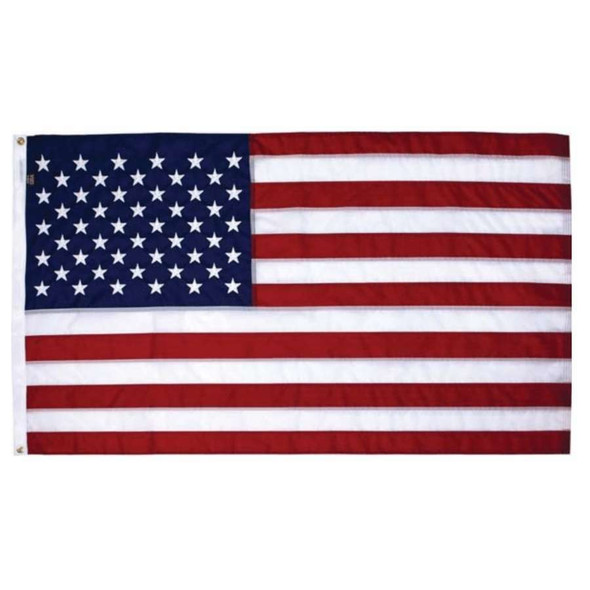
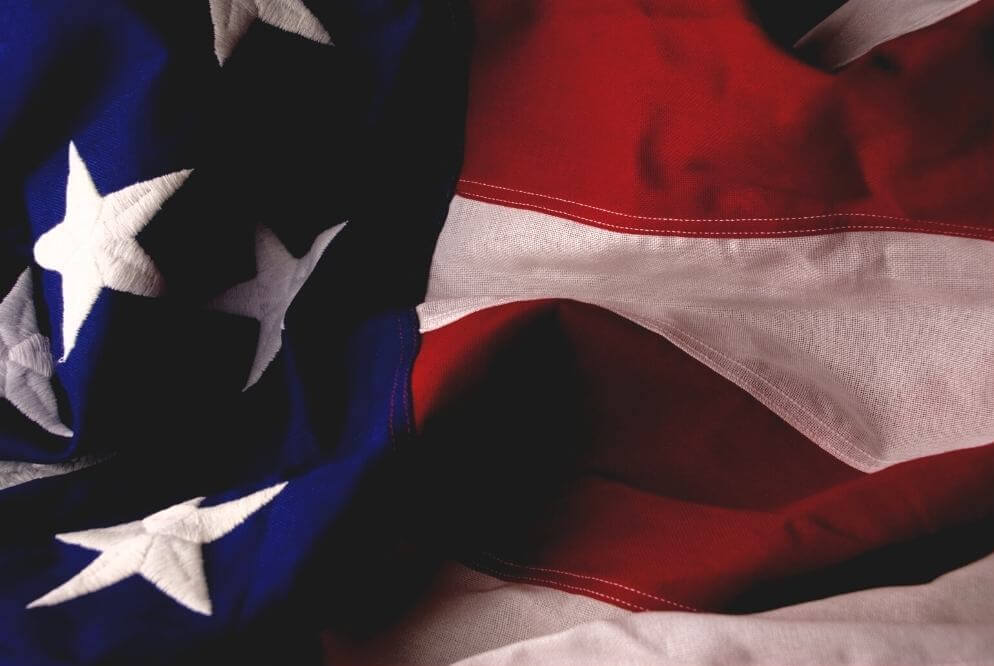
A casket (burial) flag is a 5' x 9.5' cotton United
States flag. It is used on caskets of our service
men and women if they either served at least one
enlistment or if they served in any war. They must
have had an honorable discharge.
When draping a flag on a closed casket, the "Union"
rests at the head and over the left shoulder of the
body of the deceased.
When a casket is displayed in the half-open
position, the flag is folded in thirds with the
outer fold displaying the "Union" next to the open
portion of the casket on the deceased Veteran's
left.
When a casket is displayed fully open, the flag is
folded into a triangle with only the stars and and
blue of the "Union" showing. Then, it is placed in
the center of the top portion of the casket lid just
above the left shoulder of the deceased.
According to the United States Flag Code, the burial
flag should never be allowed to touch the ground,
nor is it to be lowered into the ground with the
casket.
At the conclusion of the burial ceremony, the flag
should be lifted waist-high by the pallbearers and
held in this position for the playing of the "Taps".
At the conclusion the flag should be folded in a
triangle and presented to the deceased Veteran's
next of kin.
[Back To Top]
- What are military flag terms?
GARRISON - A garrison flag is a large US Army flag
that is flown on military posts on special days. It
has a ratio of about 1:2, with measurements of 20
feet by 38 feet.
STORM - A storm flag is a small US Army flag that is
flown on military posts during storms. It has a
ratio of about 1:2, with measurements of 5 feet by
9.5 feet.
POST - A post flag is a large US Army flag that is
ordinarily flown on military posts. It has a ratio
of about 1:2, with measurements of 8 feet 11 3/8
inches by 17 feet.
[Back To Top]
- How do I fold my flag?
Folding the
United States Flag
Step 1

To properly fold the Flag, begin
by holding it waist-high with another person so that
its surface is parallel to the ground.
Step 2

Fold the lower
half of the stripe section lengthwise over
the field of stars, holding the bottom and top edges
securely
Step 3

Fold the flag
again lengthwise with the blue
field on the outside.
Step 4

Make a triangular
fold by bringing the striped corner of the folded
edge to meet the open (top) edge of the flag.
Step 5

Turn the outer
(end) point inward, parallel to the open edge, to
form a second triangle.
Step 6

The triangular
folding is continued until the entire length of the
flag is folded in this manner.
Step 7

When the flag is
completely folded, only a triangular blue field of
stars should be visible.
Meaning of each flag fold
The first fold of our flag is
a symbol of life.
The second fold is a symbol of
our belief in the eternal life.
The third fold is made in
honor and remembrance of the Veteran departing our
ranks who gave a portion of life for the defense of
our country to attain a peace throughout the world.
The fourth fold represents our
weaker nature, for as American citizens trusting in
God, it is to Him we turn in times of peace as well
as in times of war for His divine guidance.
The fifth fold is a tribute to
our country, for in the words of Stephen Decatur,
"Our country, in dealing with other countries, may
she always be right; but it is still our country,
right or wrong."
The sixth fold is for where
our hearts lie. It is with our heart that we pledge
allegiance to the flag of the United States of
America, and to the republic for which it stands,
one nation, under God, indivisible, with liberty and
justice for all.
The seventh fold is a tribute
to our Armed Forces, for it is through the Armed
Forces that we protect our country and our flag
against all her enemies, whether they be found
within or without the boundaries of our republic.
The eighth fold is a tribute
to the one who entered in to the valley of the
shadow of death, that we might see the light of day,
and to honor mother, for whom it flies on mother's
day.
The ninth fold is a tribute to
womanhood; for it has been through their faith,
love, loyalty and devotion that the character of the
men and women who have made this country great have
been molded.
The tenth fold is a tribute to
father, for he, too, has given his sons and
daughters for the defense of our country since they
were first born.
The eleventh fold, in the eyes
of a Hebrew citizen, represents the lower portion of
the seal of King David and King Solomon, and
glorifies, in their eyes, the God of Abraham, Isaac,
and Jacob.
The twelfth fold, in the eyes
of a Christian citizen, represents an emblem of
eternity and glorifies, in their eyes, God the
Father, the Son, and Holy Ghost.
[Back To Top]
- Can I write on the flag I
purchased?
The flag should never have any mark, insignia,
letter, work, figure, picture or drawing of any
nature place upon or attached to a United States
flag.
Other flags for example solid color flags can be
purchased and altered by the purchaser. There is no
guarantee that what is used will not fade or run.
[Back To Top]
- My flag touched the ground. Do
I need to destroy the flag?
Unfortunately, there are times when the flag
accidentally touches the ground; however, this does
not mean you have to destroy the flag. Simply take
it off the ground as soon as you recognize what
happened. If necessary, clean the flag before
rehanging.
[Back To Top]
- Is it proper to fly a flag that
has been used on a casket?
Since casket flags become the property of the
Veteran's family, it is up to them how they want to
honor their loved one. In most cases, they remain
folded in a triangle and stored; however, there is
no rule saying they cannot be flown in honor of
their Veteran.
It is not recommended that these flags fly
continuously since they are cotton and only have two
rows of stitching versus the usual four rows of
stitching.
[Back To Top]
- What is the difference between
dye sublimation and appliqued?
The design is fully sewn on an appliqued flag or
banner.
On a dye sublimation flag, the image is digitally
printed on a flag or banner.
[Back To Top]
- What is the difference between
a banner and a flag?
A flag is made with grommets on the header or a pole
sleeve and flies horizontally on an in-ground pole
outrigger style flagpole.
Banners have a sleeve along the top and slide over a
pole to hang vertically. These are designed to hang
on a pole perpendicular to a building or on a wall.
[Back To Top]
- Does the flag have a warranty
or guarantee?
We guarantee that every flag we sell is free from
manufacturer's defects for a period of thirty days
from receipt of the flag. Unfortunately, we cannot
provide longer a warranty because the life of a flag
depends upon the conditions under which a flag is
flown.
To get the most wear out of your flag, we offer the
following suggestions and cautions.
All OUTDOOR FLAGS are designed to fly in the wind;
however, high winds especially accompanied by rain
will cause damage to the flag. TAKE THE FLAG DOWN
DURING STORMS WHENEVER POSSIBLE.
Keep the flag from fraying or tearing by looking at
the fly end of the flag for any signs of wear. If
wear appears, the worn part should be cut off and
the flag re-hemmed.
A clean flag will last longer. Pollutants in the air
will get into the fabric and can cause it to
degrade. To clean, wash in a mild detergent, rinse,
and hang to dry. KEEP YOUR FLAG AWAY FROM PETROLEUM
AND CHEMICAL PRODUCTS.
Never fold or store a flag when it is wet. Let it
hang dry completely before you put it away. Wet
flags will mildew and ruin the material.
INDOOR & PARADE FLAGS are damaged mainly due to
neglect. If the flag is soiled in any way, it should
be DRY CLEANED, NOT WASHED.
If an indoor flag becomes wet, it should hang to dry
completely before is it stored.
If possible, avoid exposure to direct sunlight for
long periods of time.
[Back To Top]
- Do the flags come with grommets
or do you buy them separately?
Grommets are metal rings that are punched into the
header of the flag. Clips can then be attached to
fly the flag from your halyard or pole. If you need
your flags adjusted to your personal needs
additional grommets can be purchased.
[Back To Top]
- What size flag should I buy?
There is general rule for the appropriate size flag
for a given pole. If you wish to display your flag
upon a wall please measure the desired wall space
before placing your order. Also, flags with fringe
will not hang correctly on a wall, instead we
recommend the outdoor flag with header and grommets.
GUIDELINES FOR PURCHASING OUTDOOR FLAGS
Flag Proper - Location for Display
12" x 18" - Boat
2' x 3' - House mounted flagpole
2 1/2' x 4' - House mounted flagpole
3' x 5' - House mounted or 20' flagpole
4' x 6' - 25' flagpole
5' x 8' - 30' flagpole
6' x 10' - 35' flagpole
8' x 12' - 40' flagpole
8' x 12' - 45' flagpole
10' x 15' - 50' flagpole
12' x 18' - 60' flagpole
15' x 25' - 70' flagpole
20' x 30' - 80' flagpole
GUIDELINES FOR PURCHASING INDOOR FLAGS
Flag - Proper Pole Size
2' x 3' - 6'
2 1/2' x 4' - 6'
3' x 5' - 7' or 8'
4' x 6' - 9'
5' x 8' - 12'
[Back To Top]
- Where are our flags made?
All of our Flags are made in the United States
except for the following-
- Most decorative banners
- All of our dog and cat banners.
[Back To Top]
- Glossary of Terms
Battle - A battle flag is a flag that is carried by
the armed forces on land.
Border - A bordered flag has a distinct border
around the entire flag, like that of the Maldives.
Burgee - A burgee is a long, tapered flag or pennant
that ends in a swallowtail (having two points, like
that of a swallow\'s tail). Burgees are often used
by sailing clubs.
Canton - The canton is the upper area of the flag by
the flagstaff, or a flag with a design featured in
the canton area, like the flag of Taiwan, above.
Sometimes, the word canton refers to any of the four
quarters of a flag.
Charge - The charge is the emblem or design featured
on a flag. For example, the 5 pointed star on the
Morocco flag,
Chief - The chief is the top third of the shield of
a coat-of-arms.
Civil - A civil flag is a national flag that is
displayed on land by private citizens.
Courtesy - When a ship enters a port, it often flies
the national flag of the country it is visiting as a
courtesy - this is a courtesy flag.
Defacing - Defacing (which is not vandalizing) is
when a flag is altered by adding writing, another
emblem, and so on.
Ensign - An ensign is a flag that is flown at the
back (stern) of a ship noting its nationality. For
many countries, the ensign is not the same as the
national flag; some countries have a multitude of
ensigns, designed for different types of vessels.
Field - The field is the background color of the
flag. The only national flag that is a simple field
without any designs is the flag of Libya.
Finial - A finial is a decorative element at the top
of a flagpole.
Fly - The fly is the part of the flag that is
farthest from the flagstaff.
Halyard - A halyard is the rope that is used to
raise (hoist) and lower a flag on a flagstaff.
Hoist - The hoist is the vertical measurement of a
flag (the height, or the length that runs along the
flagpole).
Jack - A jack is a flag that is flown at the front
(bow) of a ship.
Pennant - A pennant is a small, long, tapering or
triangular flag.
Ratio - The ratio of a flag is its proportions, the
height divided by the width. The ratio of a flag\'s
dimensions are usually reported as something like
2:3, which would mean that the height is 2/3 of the
width, or 1:2, which would mean that the height is
half the width.
Shield - The shield is the main part of a
coat-of-arms, and is shaped like a shield of armor.
Signal - Signal flags are flags that stand for
letters and numbers (forming coded messages). They
are used to communicate between ships at sea.
Streamer - A streamer is a long, thin flag.
Swallowtail - A swallowtail is a type of flag or
pennant that ends in two (or more) points, like the
tail of a swallow.
Union - The blue field with stars in the upper left
corner of the United States flag.
Vexillology - Vexillology is the study of flags.
[Back To Top]
- What is the meaning of each
flag fold?
The first fold of our flag is a symbol of life.
The second fold is a symbol of our belief in the
eternal life.
The third fold is made in honor and remembrance of
the Veteran departing our ranks who gave a portion
of life for the defense of our country to attain a
peace throughout the world.
The fourth fold represents our weaker nature, for as
American citizens trusting in God, it is to Him we
turn in times of peace as well as in times of war
for His divine guidance.
The fifth fold is a tribute to our country, for in
the words of Stephen Decatur, "Our country, in
dealing with other countries, may she always be
right; but it is still our country, right or wrong."
The sixth fold is for where our hearts lie. It is
with our heart that we pledge allegiance to the flag
of the United States of America, and to the republic
for which it stands, one nation, under God,
indivisible, with liberty and justice for all.
The seventh fold is a tribute to our Armed Forces,
for it is through the Armed Forces that we protect
our country and our flag against all her enemies,
whether they be found within or without the
boundaries of our republic.
The eighth fold is a tribute to the one who entered
in to the valley of the shadow of death, that we
might see the light of day, and to honor mother, for
whom it flies on mother's day.
The ninth fold is a tribute to womanhood; for it has
been through their faith, love, loyalty and devotion
that the character of the men and women who have
made this country great have been molded.
The tenth fold is a tribute to father, for he, too,
has given his sons and daughters for the defense of
our country since they were first born.
The eleventh fold, in the eyes of a Hebrew citizen,
represents the lower portion of the seal of King
David and King Solomon, and glorifies, in their
eyes, the God of Abraham, Isaac, and Jacob.
The twelfth fold, in the eyes of a Christian
citizen, represents an emblem of eternity and
glorifies, in their eyes, God the Father, the Son,
and Holy Ghost.
[Back To Top]
- What is the origin of the
American Flag?
The exact origin of the first United States flag is
in question, but some historians believe it was
designed by Congressman Francis Hopkinson and sewn
by Philadelphia seamstress Betsy Ross. It was on
June 14, 1777 that the Continental Congress passed
an Act to establish guidelines for the American
flag. They resolved that "the flag of the
United States be made of thirteen stripes, alternate
red and white; that the union be thirteen stars,
white in a blue field, representing a new
constellation." It wasn't until August 3, 1949,
that President Truman commemorated the occasion by
officially declaring June 14th as Flag Day. Between
1777 and 1960, Congress passed several acts that
changed the shape, design and arrangement of the
flag and allowed for additional stars to be added to
reflect the admission of each new state.
An Act of January 13, 1794 provided for 15 stars and
15 stripes after May, 1795. This flag was known as
the Star Spangled Banner flag.
An Act of April 4, 1818 signed by President Monroe ,
provided for 13 stripes and one star for each state,
to be added to the flag on July 4th following the
admission of each new state.
President Taft signed an executive order on June 24,
1912 establishing proportions of the flag and
provided for arrangement of the stars in six
horizontal rows of eight each and a single point of
each star to be upward.
On two occasions, President Eisenhower provided for
star arrangements on the American flag. On January
3, 1959, the stars were to be in seven rows of seven
stars each, staggered horizontally and vertically.
Then on August 21, 1959 he planned nine rows of
stars staggered horizontally and eleven rows of
stars staggered vertically.
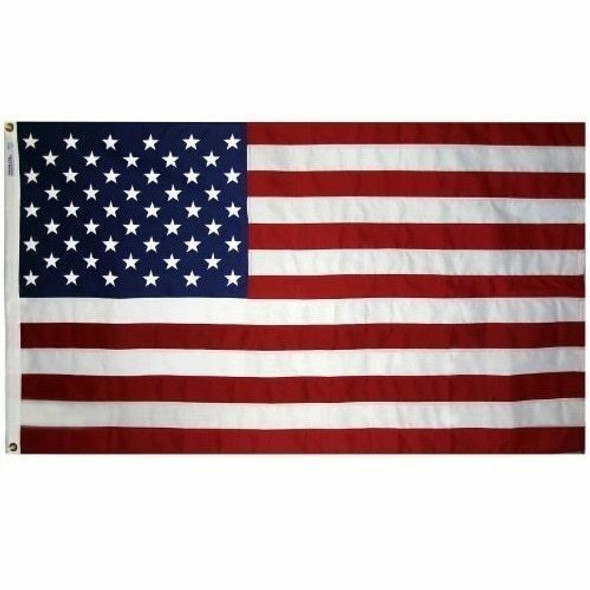
Today the flag consists of thirteen horizontal
stripes, seven red alternating with 6 white. The
stripes represent the original 13 colonies, the
stars represent the 50 states of the Union. The
colors of the flag are symbolic as well; red
symbolizes hardiness and valor; white symbolizes
purity and innocence and blue represents vigilance,
perseverance and justice.
[Back To Top]
|
|
|